
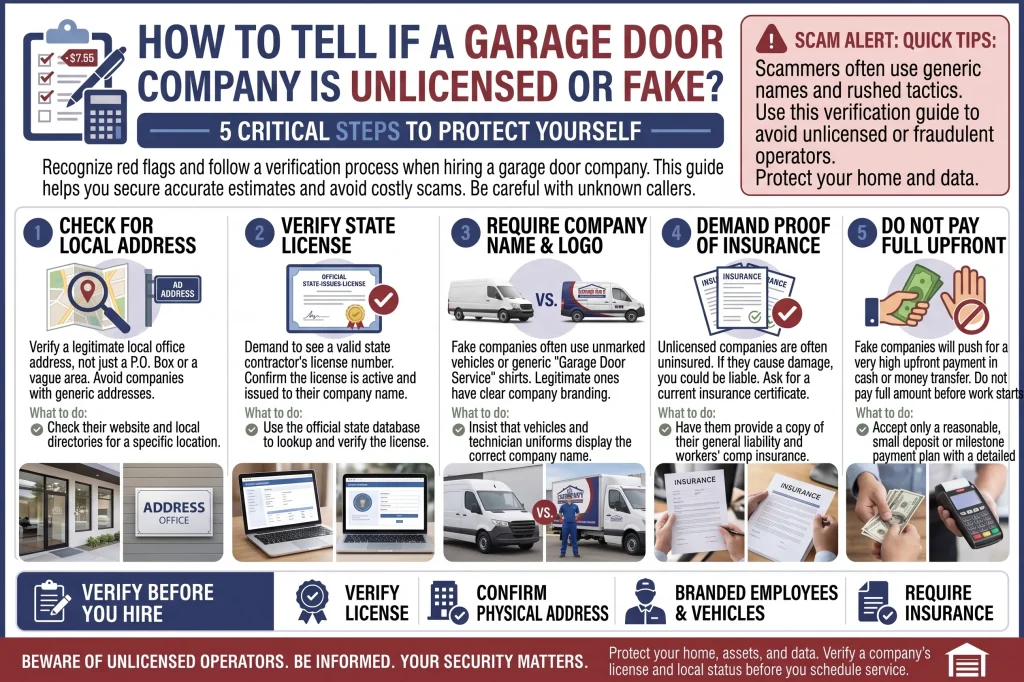
A real garage door company can give you a license number, an insurance certificate, and a verifiable business address without hesitation. A fake or unlicensed operator usually can’t, because there’s no accountable business behind the phone call.
Before you let anyone into your garage or hand over payment for garage door repair, run through five quick checks. This builds on our broader guide to phone scams and garage door companies, focused specifically on verifying licensing and legitimacy before any work begins.
Key Takeaways
- Ask for a license number directly and check it against your state’s contractor licensing lookup before scheduling.
- A real business can produce proof of insurance on request. Vague answers or refusal are a warning sign.
- Cross-check the company’s name, phone number, and address across their website, Google Business Profile, and any ad you saw.
- A branded vehicle and a business card that match the company name you called are simple, visible confirmation.
- The International Door Association flags inconsistent branding and unverifiable contact information as common warning signs of a fake operator.
Licensed Company vs. Unlicensed/Fake Operator: Quick Comparison
Signal | Licensed, Legitimate Company | Unlicensed or Fake Operator |
License number | Provided immediately, verifiable | Refused, vague, or doesn’t match records |
Insurance | Documented, provided on request | Can’t produce it, or claims it’s unnecessary |
Business address | Verifiable, matches a real location | Doesn’t resolve to a real business |
Contact info | Consistent across website and listings | Name, number, or address don’t match |
Technician arrival | Branded vehicle, ID, business card | Unmarked vehicle, no verifiable ID |
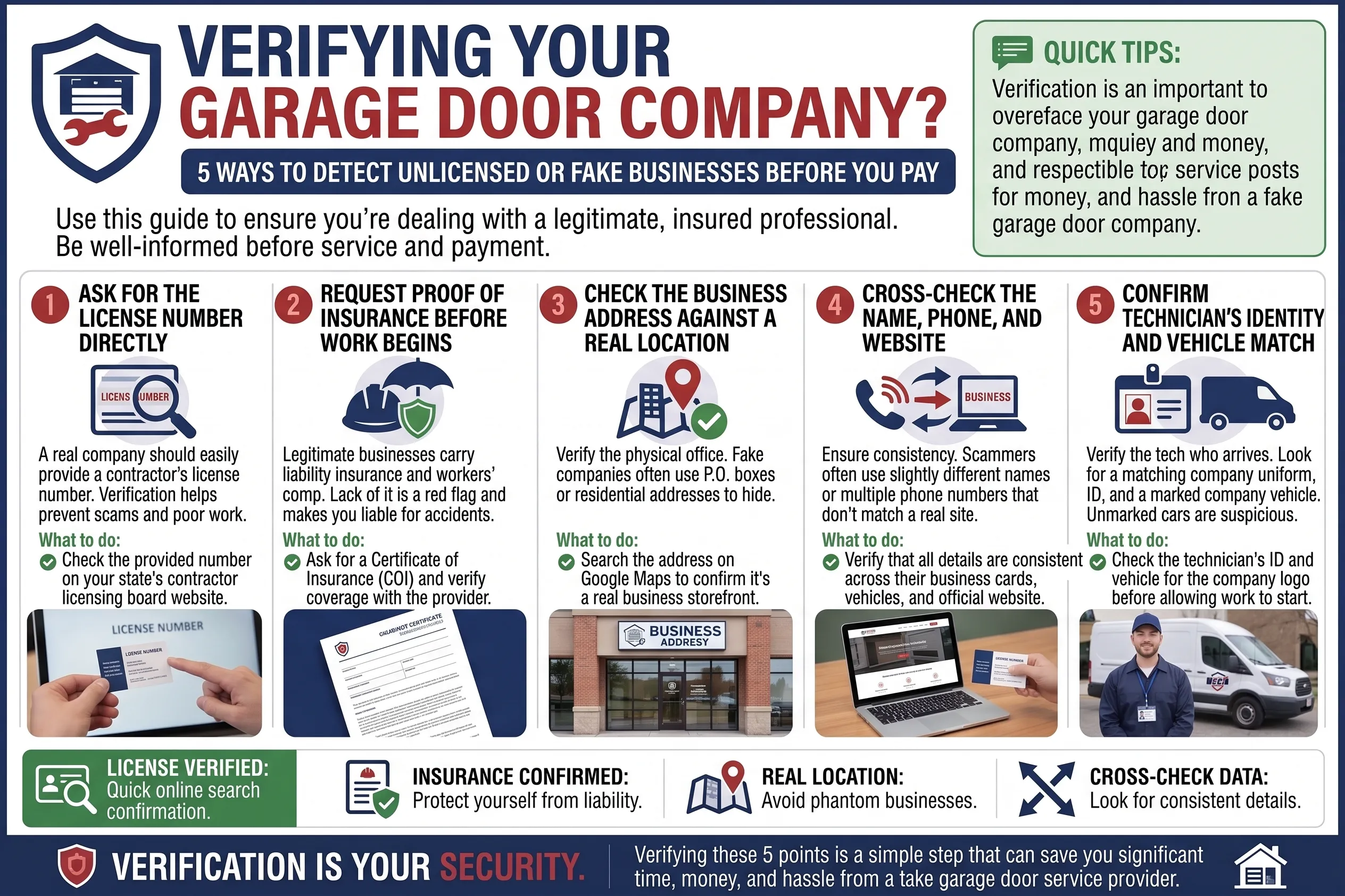
1. Ask for the License Number Directly
This is the single fastest check. A licensed company will state their license number without pushback, because they have nothing to hide. If you get a vague answer, a deflection, or a promise to “send it later,” that hesitation is itself informative.
A license number exists for a reason: it ties the business to a specific entity that a state licensing board can hold accountable, investigate, and discipline if needed. A company that operates without one has none of that accountability, which means if the work is done poorly or something is damaged, you have far less recourse. Asking for the number costs you nothing and takes seconds, which is exactly why a legitimate company will never treat the question as an inconvenience.
Call a pro if: The company won’t provide a license number when asked directly, or the number they give doesn’t match what’s listed on their own website.
How to Verify a Garage Door Company’s License Number
Ask for the number, then check it against your state’s contractor licensing lookup tool. This takes a few minutes and confirms whether the license is active and matches the business name.
- Ask for the license number directly, by phone
- Check it against your state’s contractor licensing lookup tool
- Confirm the license is active, not expired
- Confirm the name on the license matches the business name you called
If they’re also pushing you to decide today without giving you time to check any of this, read Why Do Garage Door Scammers Push Same-Day Pressure? 4 Questions to Ask Before You Let Them In.
2. Request Proof of Insurance Before Work Begins
Insurance protects you if something goes wrong during the repair, whether that’s property damage or an injury on your property. A legitimate company carries liability insurance and can produce documentation. An unlicensed or fake operator typically can’t, or will claim it’s “not necessary” for a small job.
Garage door repair involves high-tension springs, ladders, power tools, and heavy panels, all of which carry real risk of injury or property damage even during routine work. Liability insurance exists specifically to cover that risk so it doesn’t fall back on you if something goes wrong. A company that resists this question, or claims insurance only matters for “big jobs,” is quietly shifting that risk onto you without saying so directly.
Call a pro if: The company can’t provide proof of insurance, or insists insurance isn’t relevant to the work being done.
Why Insurance Verification Matters Before Hiring a Garage Door Company
If a technician is injured or your property is damaged during the repair and the company isn’t insured, you could be left covering the cost yourself. Ask for this upfront, not after the job starts. If a company also seems to skip honest pricing, read How Do Garage Door Phone Scams Use Fake Quotes? 5 Pricing Red Flags to Watch For.
3. Check the Business Address Against a Real Location
Search the company’s listed address and see if it corresponds to an actual business location, not a residential address, empty lot, or address that doesn’t match any garage door business at all. This is one of the specific checks the International Door Association recommends to homeowners.
A verifiable address matters because it’s one of the few details a scam operation can’t easily fake in a way that survives a quick search. A real, established company has a consistent physical presence, whether that’s a shop, a warehouse, or a registered office, and that presence shows up the same way across multiple sources. An operation built purely around a phone number and a website, with no findable location behind it, has structured itself specifically to be hard to trace after the fact.
Call a pro if: The address doesn’t resolve to a real, verifiable business location.
How to Confirm a Garage Door Company’s Business Address Is Real
Paste the exact address into a map search and see what comes up. A legitimate, established company will have a consistent, findable business location.
If you want to see the full range of scam tactics beyond licensing, read What to Know About Phone Scams and Garage Door Companies.
4. Cross-Check the Name, Phone Number, and Website
Scammers sometimes use a business name, phone number, or website that closely resembles a real, established company, hoping the resemblance alone will build trust. Compare what you see in an ad or search result against the company’s actual website and Google Business Profile listing.
This tactic exploits the fact that most people don’t double-check a business name closely once it sounds roughly familiar. A name that’s a near-match for a well-known local company, or a phone number that’s one digit off from the real one, can be enough to make a scam operation look legitimate at a glance. The mismatch usually only shows up when you compare details side by side, which is exactly why doing that comparison before scheduling anything is worth the extra few minutes.
Call a pro if: The phone number you called doesn’t match the number listed on the company’s own website, or the business name varies slightly between the ad, the website, and what the person on the phone tells you.
How to Spot a Fake Garage Door Company Website or Listing
Search the exact business name on its own, separate from the ad or listing you found it through, and compare every detail: name, number, and address. Inconsistencies are the tell.
5. Confirm the Technician’s Identity and Vehicle Match the Company
When someone arrives at your home, they should be able to provide a business card and identification that match the company name you actually called, and typically arrive in a marked vehicle. An unmarked personal vehicle with no verifiable ID is a legitimate reason to pause before letting anyone inside.
This final check matters because it’s the last point where you can catch a mismatch before someone is actually inside your garage. Everything up to this point has been verifiable from a distance, over the phone or online, but the moment a technician arrives is your last opportunity to confirm that the person in front of you is actually connected to the company you researched. A legitimate technician expects this question and answers it without hesitation, because their employer’s name and their own identity are exactly what they’re there representing.
Call a pro if: The technician can’t produce ID or a business card matching the company you called, or arrives in an unmarked vehicle with no company branding.
What to Check When a Garage Door Technician Arrives at Your Home
Ask for a name and company before opening the garage. If anything doesn’t match what you were told on the phone, it’s reasonable to decline and call a different company.
- Ask for the technician’s name and company before letting them in
- Confirm the vehicle matches the company’s branding, if any was mentioned
- Ask to see a business card or ID matching the company name
- Decline and call a different company if anything doesn’t match
The International Door Association’s Scam Awareness program specifically recommends this kind of on-arrival check, and the organization has also raised it in its own industry awareness posts about protecting homeowners and legitimate dealers alike.
Verify Before You Let Anyone In
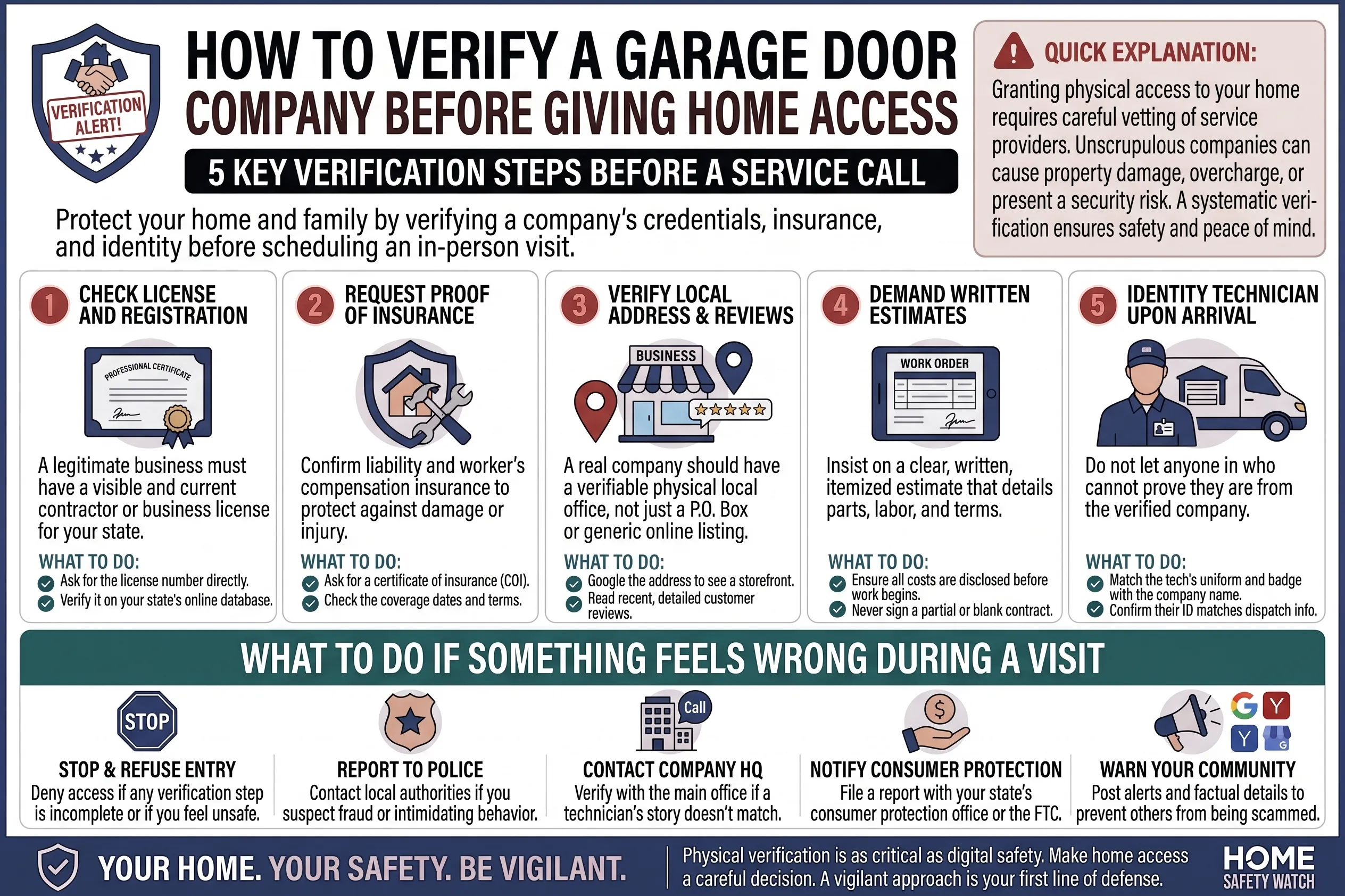
Running these five checks takes only a few minutes and can save you from a costly mistake. None of them require confrontation or special expertise, just a willingness to ask a few direct questions and compare the answers against what you can find independently.
JT’s Overhead Doors is a licensed, insured company with technicians who can be verified by name before any work begins. Contact us today or give us a call to schedule a service or request verification directly.