
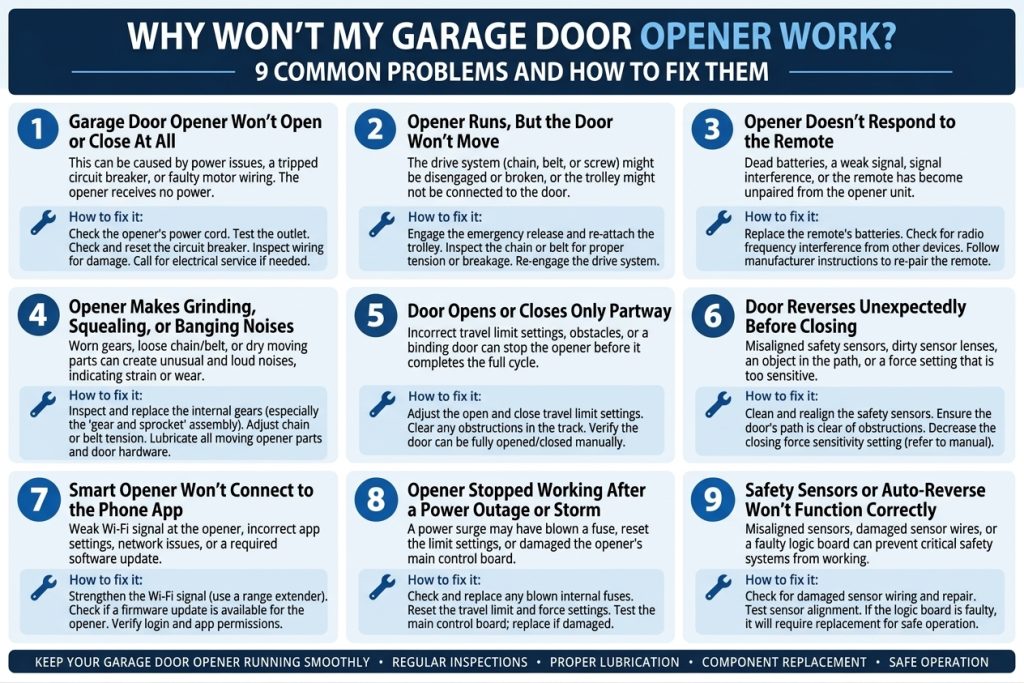
If your garage door opener won’t work, the cause is almost always one of nine things: no power, a blocked sensor, a dead battery, worn gears, a stripped belt or chain, a misadjusted limit switch, bad force settings, a WiFi issue, or a storm surge. Most take under ten minutes to identify; a few call for garage door opener repair from a pro.
Key Takeaways
- Start with power and the safety sensors. These cause the majority of “opener won’t work” calls, and both take under five minutes to check.
- A humming motor that doesn’t move the door usually points to a stripped gear or broken belt, not the motor.
- Dead remote batteries are the most overlooked fix homeowners miss before calling for service.
- Any reversing or partial-movement problem should be treated as a safety issue first.
- Smart openers add a fourth failure point (WiFi or app pairing) on top of the three mechanical ones.
- Past eight years old with frequent problems, replacement is often more cost-effective than repeated repairs.
Symptom, Likely Cause, and Urgency: Quick Reference
Symptom | Likely Cause | Urgency |
No response at all | No power or blocked sensors | Same day |
Motor hums, door doesn’t move | Stripped gear or broken belt/chain | Same day |
Remote doesn’t work | Dead batteries or lost programming | Low |
Grinding or squealing noise | Worn gears or loose hardware | Moderate, worsens over time |
Door stops partway | Misaligned limit switch or track obstruction | Moderate |
Door reverses before closing | Misaligned sensors or force setting | Moderate to high (safety-related) |
Smart opener offline in app | WiFi signal or pairing issue | Low |
Stopped after outage or storm | Lost programming or surge damage | Moderate to high, depending on cause |
Auto-reverse doesn’t trigger | Sensor or wiring fault | High, safety hazard |
1. Garage Door Opener Won’t Open or Close At All
The opener seems completely dead: no light, no motor sound, nothing.
Most likely cause: No power, or blocked/dirty sensors.
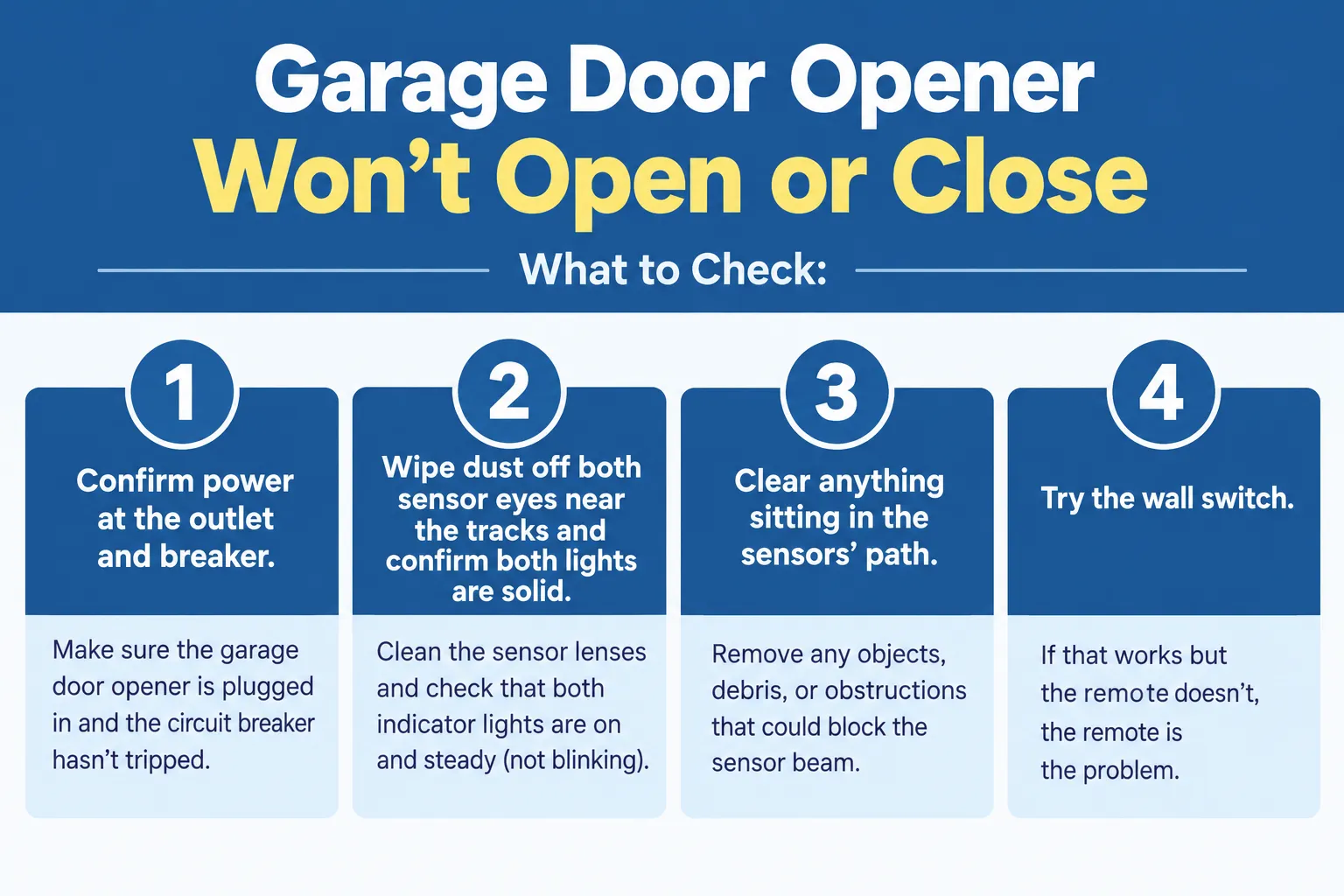
What to check:
- Confirm power at the outlet and breaker.
- Wipe dust off both sensor eyes near the tracks and confirm both lights are solid.
- Clear anything sitting in the sensors’ path.
- Try the wall switch. If that works but the remote doesn’t, the remote is the problem.
Call a pro if: power and sensors check out, but there’s still no response (circuit board or motor failure). LiftMaster and Chamberlain models flash a diagnostic code you can look up on the manufacturer’s official support portal.
How to Fix a Garage Door Opener That Won’t Open or Close
Check power, then sensors, then the wall switch, in that order.
2. Opener Runs, But the Door Won’t Move
The motor hums or clicks like it’s trying, but the door doesn’t budge.
Most likely cause: A stripped drive gear (common after 8-10 years) or a broken belt/chain.
What to check:
- Listen for a grinding or high-pitched whine, which usually means a stripped gear.
- Check whether the trolley is still attached and moving with the motor.
- Look for a sagging or off-track chain or belt.
Call a pro if: the gear is stripped or the belt/chain is damaged, since it involves opening the unit housing.
Why a Garage Door Opener Runs But the Door Won’t Move
The disconnect is mechanical, not electrical.
3. Opener Doesn’t Respond to the Remote
The wall switch works, but the remote doesn’t.
Most likely cause: Dead batteries or lost programming after an outage.
What to check:
- Replace the batteries first, which solves most remote complaints.
- If that doesn’t help, reprogram the remote using your opener brand’s “learn” button process.
- Rule out interference from nearby garages.
Call a pro if: reprogramming doesn’t restore the connection; the receiver may need replacement.
How to Fix a Garage Door Opener That Won’t Respond to the Remote
Replace the batteries, then reprogram, then check for interference.
4. Opener Makes Grinding, Squealing, or Banging Noises
A noisy opener rarely fixes itself; the noise usually worsens over weeks.
Most likely cause: Dry or worn gears, loose hardware, or a belt/chain needing tension.
What helps: Loose hardware and dry parts are the most common causes, and a technician typically tightens and lubricates both during a tune-up. Regular garage door maintenance catches this wear before it becomes a bigger repair.
Call a pro if: the noise is a sharp bang or pop, which can indicate a spring issue. Springs carry serious tension and should only be handled by a professional.
What Causes a Garage Door Opener to Grind or Squeal
Dry parts are the top cause and the easiest to prevent.
5. Door Opens or Closes Only Partway
The door starts moving, then stops or reverses before it’s fully open or closed.
Most likely cause: Misaligned limit switches or an obstruction in the track.
What helps: Check both tracks for debris and look at rollers for visible wear; a stuck roller can stop the door mid-travel. Limit switch adjustment is model-specific and best left to a technician.
Call a pro if: clearing the tracks doesn’t help, or the door is unbalanced (won’t stay in place when moved by hand). An unbalanced door will keep causing this problem until corrected.
How to Fix a Garage Door Opener That Stops Partway
Rule out a track obstruction first, then check the limit switches or balance.
6. Door Reverses Unexpectedly Before Closing
The door starts to close, then suddenly goes back up, even with nothing in the way.
Most likely cause: Misaligned or dirty sensors, or a force setting that’s too high.
What helps: Check whether both sensor lights face each other and are free of dust; even a slight tilt causes false reversals. If sensors check out fine, the close-force setting likely needs adjusting by a technician.
Call a pro if: sensors are aligned and clean, and the door still reverses; this shouldn’t be worked around.
The Door and Access Systems Manufacturers Association’s safety guidelines for garage door openers note that this sensitivity adjustment should be handled by a trained door systems technician, since setting it incorrectly can create a genuine safety hazard.
Why a Garage Door Opener Reverses Before Closing
It’s the sensors far more often than the door.
7. Smart Opener Won’t Connect to the Phone App
The opener works fine with the wall switch and remote, but the app shows it offline or won’t pair.
Most likely cause: Weak WiFi signal in the garage, a pending app or firmware update, or the opener needing to re-pair to your network.
What to check:
- Confirm your WiFi actually reaches the garage; an extender solves this more often than expected.
- Check for a pending app or firmware update.
- Remove and re-add the device in the app to force a fresh pairing.
Call a pro if: re-pairing repeatedly fails, since the WiFi module can fail even when the mechanics work fine. If so, read Why Won’t My Garage Door Opener Connect to My Phone App for the full walkthrough.
How to Fix a Garage Door Opener That Won’t Connect to WiFi
Weak signal is the top cause, so confirm coverage first.
8. Opener Stopped Working After a Power Outage or Storm
Everything worked before the outage, and now the opener won’t respond or behaves strangely.
Most likely cause: Lost programming, surge damage to the circuit board, or a dead battery backup (on models that have one).
What to check:
- Try the manual reset many openers require after power loss (check your model’s manual).
- Reprogram remotes and keypads if they stopped working.
- Confirm the backup battery itself isn’t dead, if your model has one.
Call a pro if: you notice signs of electrical damage (burnt smell, scorch marks, no power-on at all). If it’s post-storm, read Why Does My Garage Door Opener Stop Working After a Power Outage? for the full walkthrough.
Why a Garage Door Opener Stops Working After a Power Outage
Usually lost programming, an easy fix, unless it’s surge damage.
9. Safety Sensors or Auto-Reverse Won’t Function Correctly
The auto-reverse feature doesn’t stop the door when something is in its path, a genuine safety hazard, not just an inconvenience. This dual-sensor requirement, an inherent reversal system plus a photo eye or edge sensor, comes from UL 325, the federal safety standard for automatic garage door operators, which every opener sold in the U.S. since 1993 must meet.
Most likely cause: Misaligned sensors, wiring damage, or an off sensitivity setting.
What to check:
- Place a block of wood in the door’s path and try closing it; the door should reverse immediately on contact.
- If it doesn’t reverse, stop using the opener until it’s repaired.
- Check sensor wiring near the base of the tracks for pinches or fraying.
Call a pro if: the auto-reverse test fails; a door that won’t auto-reverse is a hazard to people, pets, and vehicles.
How to Test and Fix Garage Door Opener Auto-Reverse Safety
The wood-block test confirms it in thirty seconds. If it fails, stop using the door.
Getting Your Opener Back to Reliable Operation
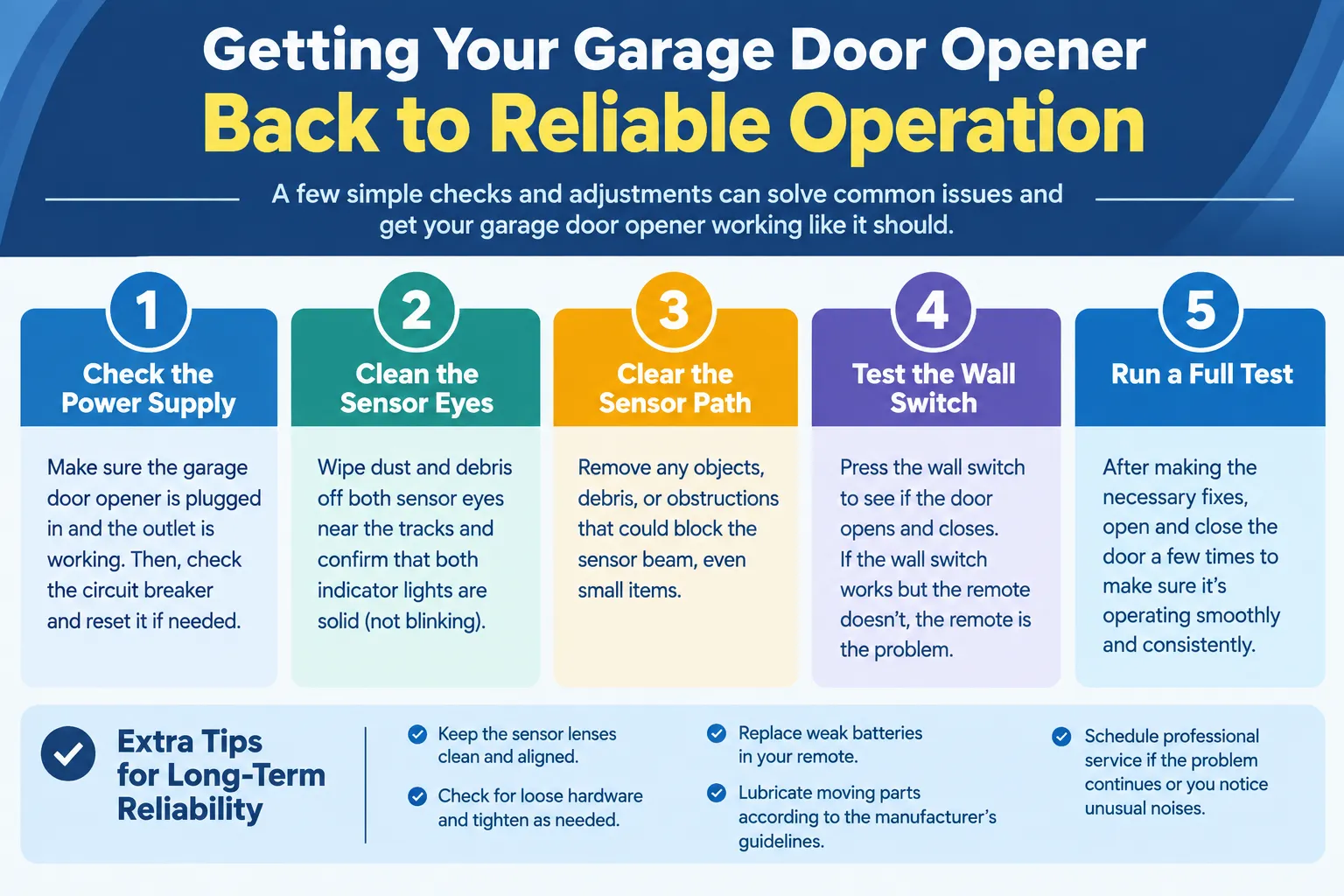
Most opener problems trace back to one of the nine issues above, quick to diagnose once you know where to look. Stripped gears, electrical damage, or sensor failures are worth having checked by a professional rather than worked around.
JT’s Overhead Doors has served Mesa and the surrounding valley since 1972, with same-day opener repair available for most of the issues above. If your opener still isn’t working the way it should, contact us today or give us a call for a free quote.