
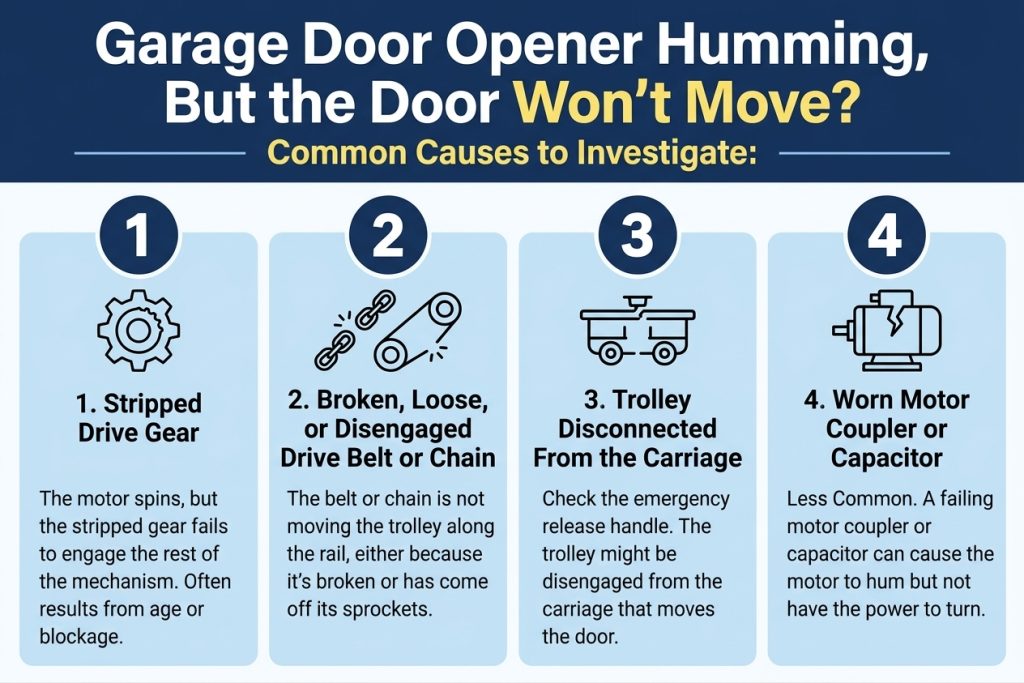
A garage door opener that hums or clicks but doesn’t move the door almost always means the motor is running fine, but something between the motor and the door has failed: a stripped drive gear, a broken or disengaged drive belt or chain, or a trolley that’s come loose from the carriage. This is a mechanical disconnect, not an electrical one, and it’s one of the most common garage door opener repair calls across Mesa and the surrounding valley. The motor itself is rarely the actual problem, even though it sounds like it’s straining.
Key Takeaways
- If the motor sounds like it’s working but the door doesn’t budge, the problem is almost never the motor itself.
- Stripped plastic drive gears are the single most common cause, especially on openers older than 8 years, since most residential units use a plastic gear by design to protect the more expensive motor from damage.
- You can often narrow down which part failed just by opening the trolley release and checking whether the carriage moves freely by hand.
- This is a repair, not usually a full opener replacement, unless the unit is already near the end of its life or the damage has spread to multiple components.
- Don’t keep running the opener once you notice this symptom. Continuing to try can damage the motor housing, strip the gear further, or place unnecessary strain on the door itself.
- A hum that starts quiet and grows louder over several days or weeks usually means a gear is actively wearing down, not that something failed all at once.
Which Part Is Actually Failing
Cause | How to Tell | Who Should Fix It |
Disconnected trolley | Trolley hanging loose near the door | You can check this yourself |
Loose or worn chain/belt tension | Sagging or off-track chain/belt | Technician |
Stripped drive gear | Grinding or whirring under the hum | Technician |
Broken belt or chain | Motor hums, nothing moves at all | Technician |
Worn coupler or capacitor | All of the above ruled out | Technician, needs diagnostic equipment |
1. Stripped Drive Gear
This is the most frequent cause by far, particularly on chain-drive and screw-drive openers with an internal plastic gear. Most residential openers use a plastic gear on purpose: it’s designed to be the weakest link in the drive system, so it wears out and fails before the more expensive motor does. That’s good engineering, but it also means this is the part you’ll replace most often over the life of an opener.
How to tell: The motor hums steadily, but you may also hear a faint grinding or whirring underneath the hum. Over time, the gear’s teeth wear down until they can no longer grip the drive mechanism, and the motor simply spins without transferring any force to the door. This wear is usually gradual, so a hum that’s gotten louder over the past few weeks is a good sign the gear is already partway worn.
What helps: This requires opening the opener’s gear housing near electrical components, so it’s a repair for a technician rather than a homeowner project. A stripped gear kit replacement typically takes under an hour once diagnosed, and most service trucks carry the part for major opener brands.
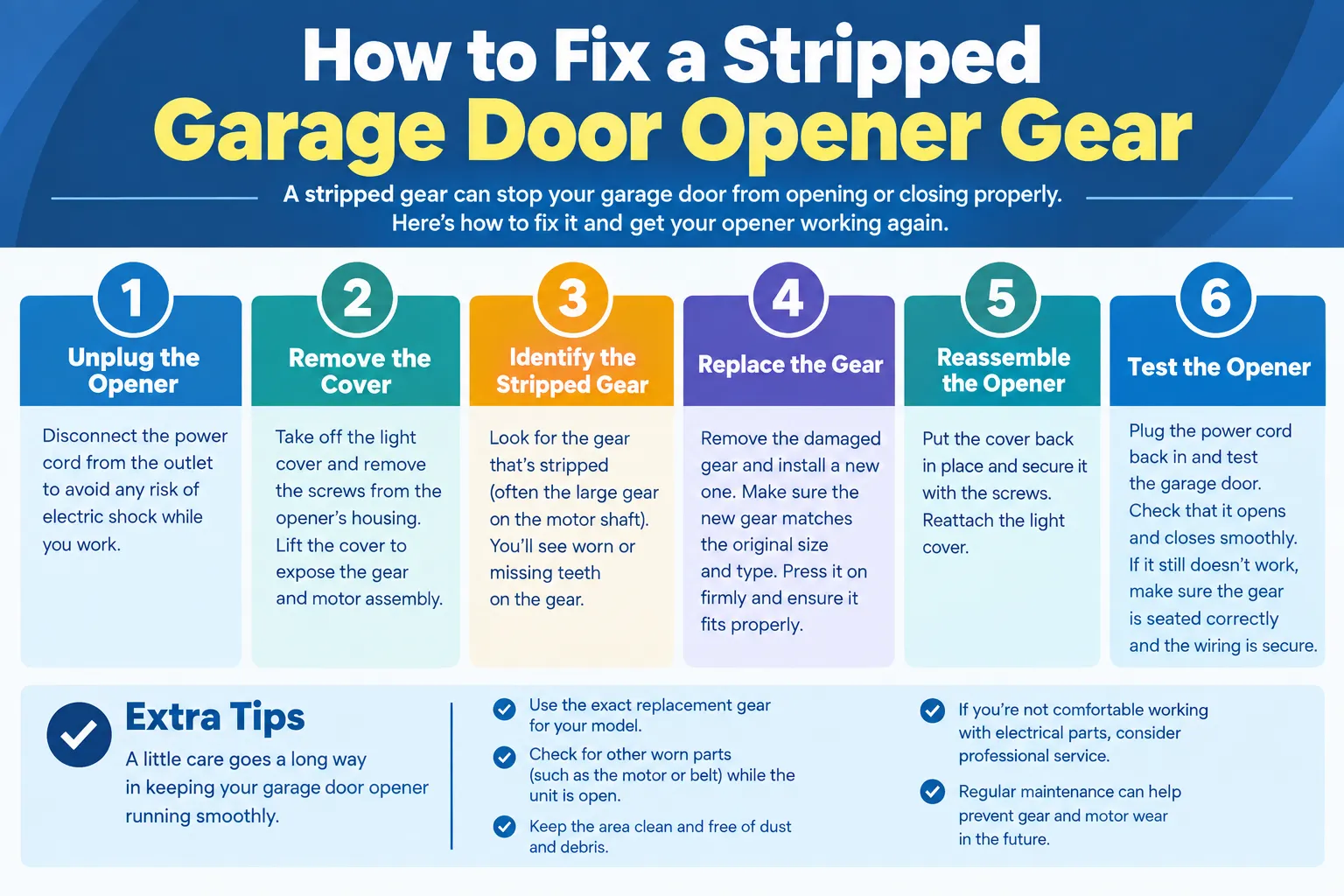
How to Fix a Stripped Garage Door Opener Gear
A stripped gear kit replacement typically takes a technician under an hour once diagnosed, and most service trucks carry the part for major opener brands.
For other common opener issues and fixes, from dead remotes to sensors that won’t align, read Why Won’t My Garage Door Opener Work? 9 Common Problems and How to Fix Them.
2. Broken, Loose, or Disengaged Drive Belt or Chain
The belt or chain is what actually pulls the trolley (and therefore the door) along the rail. If it snaps, slips off, or comes loose, the motor spins with nothing to move, producing the same humming symptom as a stripped gear even though the cause is different.
How to tell: Look along the rail above the door. A sagging belt or chain, or one visibly off its track, confirms this. On chain-drive openers, you may also notice the chain has a lot of slack compared to when the opener was installed, or that it’s developed a visible kink.
What helps: Chain tension is model-specific, and a snapped belt or chain needs full replacement plus a travel-limit reset. Both are best handled by a technician to avoid recreating this same problem a few months later.
If you’re not sure how often this wear should be checked, read the International Door Association’s safety and maintenance guidance, or ask about it during your next garage door maintenance visit.
Call a pro if: the belt or chain is sagging, off-track, or visibly snapped.
Why a Garage Door Opener Belt or Chain Comes Loose
Age and heat cycling are the two biggest factors. Arizona’s summer heat accelerates wear on rubber drive belts specifically, since the material expands and contracts repeatedly through daily temperature swings, so this failure shows up more in older belt-drive units here than it does in milder climates.
3. Trolley Disconnected From the Carriage
Every opener has a manual release mechanism (the red pull cord) that disconnects the trolley from the motor carriage for manual operation, typically used during a power outage or when moving a car in and out for something like a garage sale. Sometimes this gets triggered accidentally, brushed by a stored ladder or a tall item being moved through the garage, or it doesn’t fully re-engage after being used.
How to tell: Look at the point where the rail meets the top of the door. If the trolley arm looks disconnected or is hanging loosely rather than sitting flush against the carriage, this is likely it. This is also worth checking anytime someone in the household mentions using the manual release recently.
What helps: The release cord can be pulled toward the motor to re-engage the mechanism. If this holds and the opener responds normally afterward, that confirms the cause, and there’s nothing further to do. If it doesn’t hold, or it disconnects again shortly after, the trolley mechanism itself may be damaged and worth having looked at.
Call a pro if: re-engaging doesn’t hold, or the trolley mechanism itself looks damaged.
If the power goes out, this same manual release lets you open the door by hand; read Why Does My Garage Door Opener Stop Working After a Power Outage? for that scenario.
How to Tell If a Garage Door Opener Trolley Has Disconnected
This is the quickest cause to rule out on this list, so it’s worth checking first before assuming a gear or belt problem, since it takes only a moment to look and costs nothing to try.
4. Worn Motor Coupler or Capacitor (Less Common)
On some models, a worn internal coupler between the motor and drive mechanism, or a failing start capacitor, can cause humming without movement even when the gears and belt are fine. The coupler is a small connecting piece that transfers rotational force from the motor shaft to the drive system, and like the plastic gear, it’s sometimes designed to wear out before more expensive components do.
How to tell: This is harder to self-diagnose than the other three causes, since there’s no visible sagging chain or disconnected trolley to look for. If gears, belt, and trolley all check out fine and the opener still hums without moving the door, this is the next likely culprit.
As Family Handyman’s overview of how different opener types are built explains, some models even keep the chain or belt stationary and move the motor itself along the trolley, which is one reason worn internal components can be harder to diagnose from the outside.
Call a pro if: the first three causes are ruled out. This typically requires professional diagnostic equipment to isolate the exact failed component.
What a Worn Coupler or Capacitor Sounds Like
Both failures tend to produce a steady hum without the grinding or whirring associated with a stripped gear, which is one clue a technician uses to narrow down the cause before opening the unit.
If your opener’s trouble is with its smart features rather than movement, read Why Won’t My Garage Door Opener Connect to My Phone App for that separate troubleshooting path.
Getting the Door Moving Again
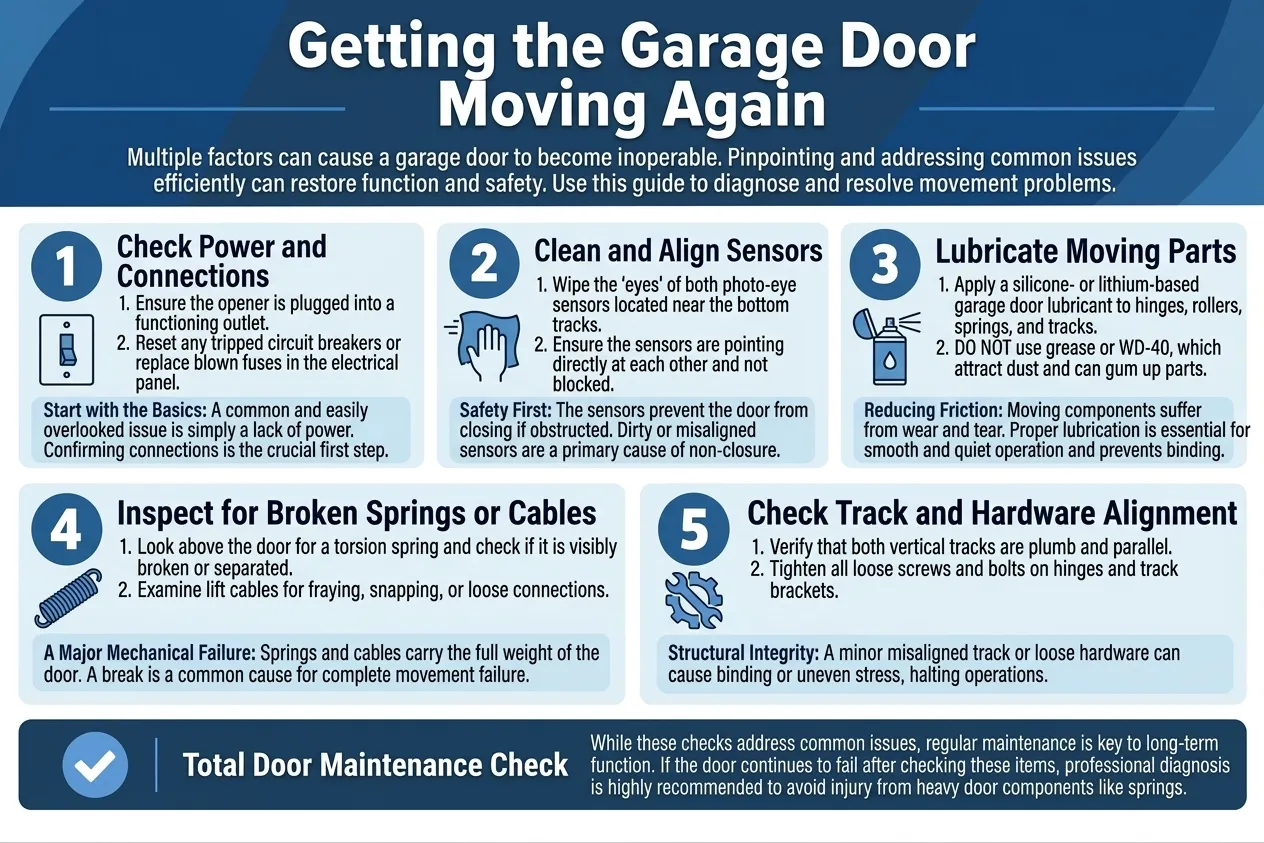
Check the trolley connection first since it’s the easiest and fastest thing to rule out, then look at the belt or chain along the rail, then suspect the gear if both of those check out fine.
JT’s Overhead Doors offers same-day diagnostic and repair for humming openers across Mesa and the surrounding valley. If your opener is humming and stuck, contact us today or give us a call to get it moving again.