

There is a big difference between a garage door roller that needs attention and one that needs to be replaced. Knowing which situation you are dealing with can save you from paying for garage door repair that will not last or delaying a necessary replacement that your system cannot afford to wait on. In many cases, a professional garage door service can properly inspect the rollers and determine whether a simple adjustment or a full replacement is the safer and more cost-effective option.
Rollers do not last forever. They are mechanical parts that wear down through thousands of open and closed cycles, exposure to heat and dust, and constant vibration from daily use. In Mesa, AZ, where temperatures regularly push hardware to its limits, rollers often wear out faster than expected. Staying consistent with garage door service helps identify early signs of wear and reduces the risk of sudden failure that could lead to more extensive garage door repair.
The Roller Wheel Has Visible Cracks or Chips
Physical damage to the roller wheel is the most straightforward sign that replacement is needed. A wheel that is cracked, chipped, or missing sections cannot roll smoothly through the track. It creates friction, catches on the track surface, and puts uneven stress on the door panels and surrounding hardware with every cycle, often indicating the need for garage door service to prevent further damage and maintain safe operation.
What damaged wheels look like:
- A crack running through the center or along the edge of the wheel
- Chunks missing from the wheel surface, leaving a rough, uneven edge
- Flat spots on the wheel where the surface has worn down unevenly
- A wheel that appears warped or no longer round when you look at it straight on
To understand what happens to the rest of your door system when a roller repeatedly comes off and is put back without being replaced, What Happens If You Ignore a Fallen Garage Door Roller? walks through the full chain of consequences.

The Rollers Are Showing Signs of Wear That Lubrication Cannot Resolve
A certain amount of sound from a garage door during operation is normal. What is not normal is noise that persists after fresh lubrication has been applied, or noise that has changed in character, getting louder, rougher, or occurring at new points in the door’s travel.
Sounds that point to replacement rather than lubrication:
- A grinding or scraping sound that continues after the rollers have been freshly lubricated
- A rhythmic thumping that happens at a consistent interval during travel, which often indicates a flat spot on a wheel
- A sharp clicking or cracking sound, which can mean the roller wheel is fragmenting during operation
- A rattling sound from the roller bracket area, even when the door is not moving
The Roller Stem Is Bent or Damaged
The stem is the shaft that runs through the center of the roller wheel and connects to the bracket on the door panel. It is what holds the roller in its position along the track. When the stem bends, even slightly, the wheel no longer sits straight in the track. Instead, it runs at an angle, creating friction on one side and allowing the opposite side to lift partially out of the track channel.
How to spot a bent stem:
- Look at the roller from the side. The wheel should sit perfectly perpendicular to the door panel. If it tilts inward or outward, the stem is likely bent.
- A roller with a bent stem often wobbles noticeably when the door is in motion, even if the wheel itself looks intact.
- The bracket may also look stressed or pulled at an angle due to the force the bent stem is placing on it.
The Roller Keeps Coming Out of the Track
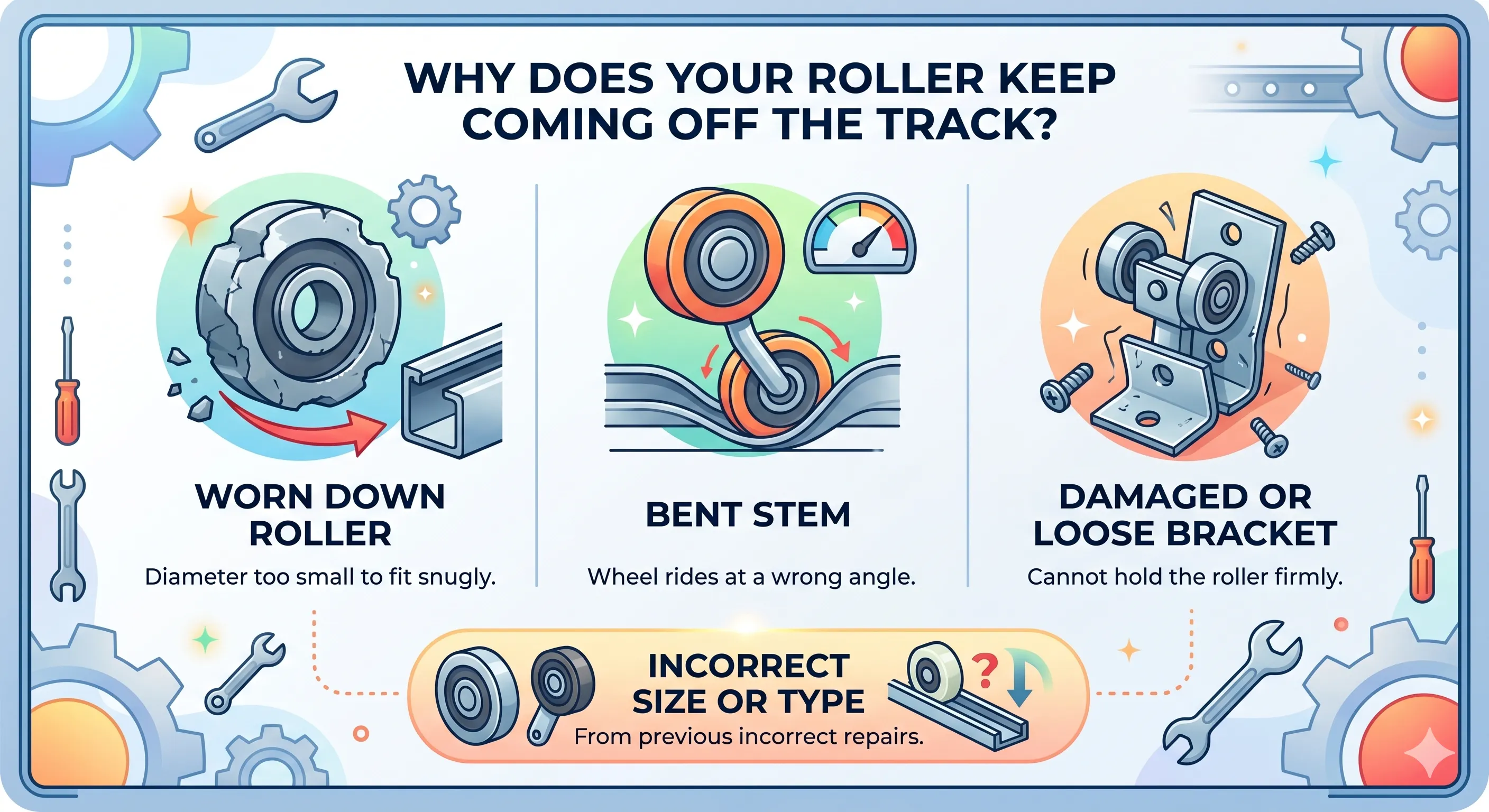
If a roller has already come out of the track once, and it happens again after being put back in, that is a clear signal that something is wrong with the roller itself, the bracket holding it, or both. A properly functioning roller in a properly aligned track does not repeatedly fall out on its own.
Reasons a roller keeps leaving the track:
- The wheel diameter has worn down enough that it no longer fits snugly in the track channel, allowing it to slip out under load
- The stem is bent, causing the wheel to ride at an angle that pushes it toward the edge of the track
- The bracket is damaged or loose, so the roller is not held firmly in position during operation
- The roller is the wrong size or type for the track, a problem that sometimes occurs after a previous repair used incorrect parts
The Roller Has Visible Rust or Corrosion
Rust on a garage door roller is more than a cosmetic issue. Corrosion changes the surface texture of the wheel and stem, making them rough where they need to be smooth. A rusted wheel does not roll freely through the track. It drags, creates friction, and leaves debris inside the track channel that compounds the problem over time.
Where rust appears on rollers:
- Along the stem, particularly where it meets the bracket
- On the surface of the wheel itself, especially on steel rollers in environments with moisture or humidity exposure
- Inside the bearing, which is not always visible but shows up as resistance when you try to spin the wheel by hand
The test for bearing rust:
Hold the roller stem firmly and try to spin the wheel with your fingers. A healthy roller spins freely with almost no resistance. A roller with corroded bearings feels stiff, gritty, or stops partway through a turn. Once the bearing is corroded, the roller cannot be restored to proper function through lubrication alone.
The Door Is Visibly Uneven to Travel Smoothly
This sign is about what the door is doing rather than what the roller looks like. When one or more rollers are worn to the point of replacement, the door often shows it through changes in how it moves. These changes are easy to spot once you know what to watch for.
Door behavior that points to roller replacement:
- One side of the door rises or lowers faster than the other, causing the door to look crooked mid-travel
- The door hesitates, jerks, or stops at a specific point in its travel every time it operates
- The door feels significantly heavier when operated manually than it used to
- The opener struggles or triggers its safety reversal during normal operation without any obstruction present
- The door does not sit level when fully closed, with one corner higher or lower than the opposite side
For a complete guide on the steps that keep rollers performing well and delay the need for replacement, How to Keep Garage Door Rollers From Falling Off covers the maintenance habits that extend roller life significantly.
The Rollers Have Exceeded Their Expected Cycle Life
Every roller has a rated service life measured in cycles, and once that threshold is reached, the hardware is statistically more likely to fail, sometimes requiring garage door repair or emergency service if a sudden breakdown occurs. You do not have to wait for a visible symptom to replace rollers. Knowing when they are due based on age and usage is a valid reason to replace them proactively and maintain safe operation through regular garage door service.
Typical cycle ratings by roller type:
- Basic steel rollers: 10,000 to 15,000 cycles
- Standard nylon rollers with unsealed bearings: 10,000 to 15,000 cycles
- Nylon rollers with sealed ball bearings: 20,000 cycles or more
Industry safety organizations recommend routine inspection intervals to ensure mechanical components are replaced before reaching end-of-life failure thresholds.
You Are Hearing Grinding Sounds From the Bearing Area
This sign is specific enough to deserve its own section. A grinding sound that comes from the center of the roller wheel, rather than from the wheel surface against the track, points to bearing failure. The bearing is the set of small steel balls inside the roller hub that allows the wheel to spin freely around the stem. When the bearing wears out or corrodes, the balls no longer roll smoothly and the wheel begins to grind as it rotates.
How to distinguish bearing noise from other roller sounds:
- Bearing noise tends to be consistent and rhythmic, occurring with every rotation of the wheel
- It often sounds like a low grinding or crunching rather than a surface scrape
- The sound is coming from within the roller itself, not from the wheel against the track
Compliance with established garage door safety standards helps ensure mechanical parts operate smoothly and reduces the risk of bearing-related failure.
Your Rollers Are Steel, and Your Door Is Heavy or High-Use
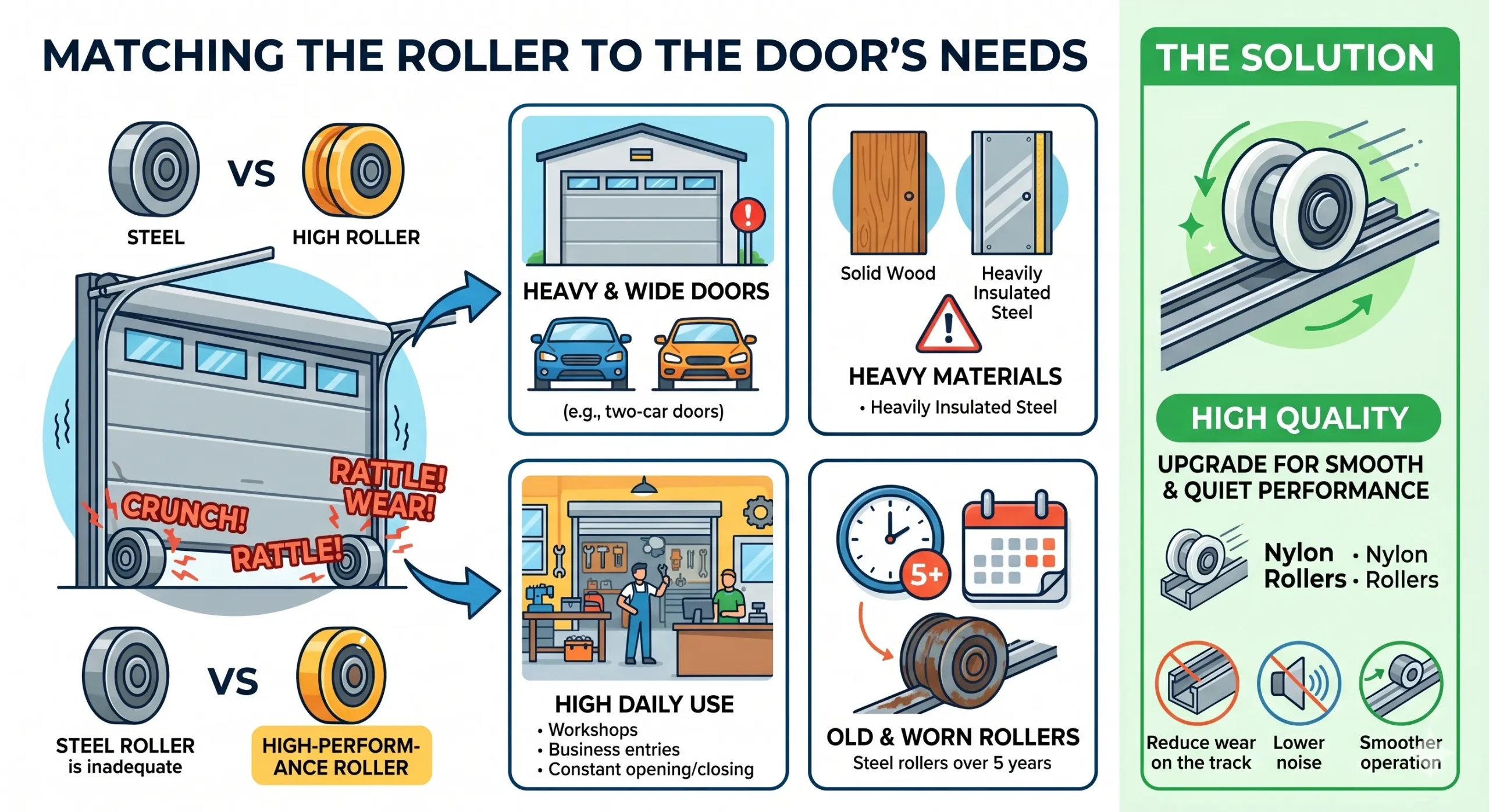
This sign is about a mismatch between the roller type and the demands being placed on it. Standard steel rollers are adequate for lighter doors with average use. But when a door is heavier, taller, or gets used more frequently than average, steel rollers tend to wear out faster and can contribute to track wear and noise issues that higher-quality rollers would not cause.
When steel rollers are likely underperforming:
- The door is a double-wide (two-car) door, which is heavier than a single
- The door material is solid wood or heavily insulated steel
- The garage is used as a workshop or business entry, resulting in higher daily cycle counts
- The door has been running on the same steel rollers for more than five years
A Professional Inspection Has Flagged Them for Replacement
Sometimes the sign is not something you spot yourself. A garage door technician inspecting your system identifies rollers that are at or near the end of their service life before any symptoms have become obvious to you.
This is one of the most valuable reasons to schedule annual professional maintenance. Technicians check roller condition as part of a full system inspection, and they can identify internal bearing wear, early-stage cracking, and stem fatigue that is not visible to someone without training or the right tools.
What a technician looks for that homeowners typically cannot:
- Internal bearing play, felt by gripping the wheel and checking for wobble or resistance
- Early stem fatigue in the metal before it has bent noticeably
- Wear patterns on the track surface that indicate a roller has been running improperly
- Rollers that are visually intact but have logged enough cycles to be statistically near failure
To understand what causes rollers to reach this point and how the wear process develops over time, What Causes Garage Door Rollers to Fall Off? covers the full picture from start to finish.
Time to Make the Call on Your Garage Door Rollers
Knowing when to replace your garage door rollers is not about waiting until something breaks. It is about reading the signs your door is already giving you and acting before a worn roller becomes a damaged track, a stressed opener, or a door that refuses to close properly.
JT’s Overhead Doors helps homeowners in Mesa, AZ make informed decisions about roller replacement and overall system condition. In this climate, rollers that might last a decade elsewhere often need attention sooner due to heat, dust, and daily usage demands on every component. Staying ahead of that wear keeps your garage door running safely and reliably. Contact us today or give us a call to schedule your inspection.